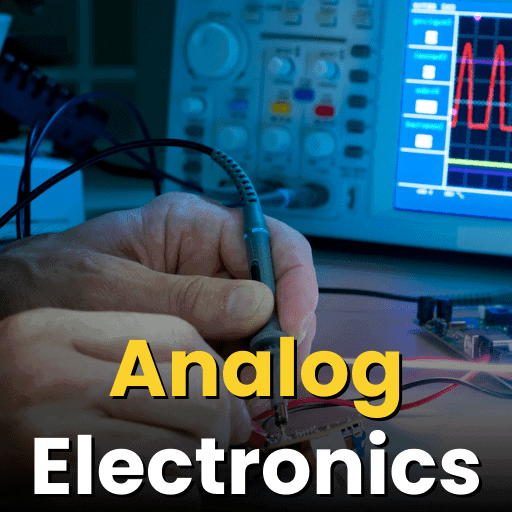
 | INFINITY COURSE Analog Digital Electronics Books, Notes & Tests 202628,600 students learning this week · Last updated on Apr 14, 2026 |
Analog Digital Electronics Books, Notes Study Material



Trending Courses for Electrical Engineering (EE)

What is Analog and Digital Electronics for Electrical Engineering?
Analog and Digital Electronics is a fundamental subject for anyone preparing for Electrical Engineering competitive examinations like GATE (Graduate Aptitude Test in Engineering), ESE (Engineering Services Examination), and various PSU recruitment tests. This course forms the backbone of modern electronics and telecommunication systems that power everything from smartphones to industrial automation.
The subject encompasses two distinct yet interconnected domains: analog electronics, which deals with continuous signals and their processing, and digital electronics, which focuses on discrete signal manipulation using logic gates and binary systems. Understanding both domains is essential for any aspiring electrical engineer in India preparing for competitive exams or pursuing a career in the field.
Why Analog and Digital Electronics Matter
In today's world, virtually every electronic device combines both analog and digital components. Analog and Digital Electronics for Electrical Engineering equips you with knowledge to design circuits, understand signal processing, and grasp the fundamentals of integrated circuit design. Whether you're appearing for GATE EE or ESE Electrical Engineering exams, mastering these concepts directly impacts your success.
Key Topics Covered in Analog and Digital Electronics Course
The comprehensive curriculum of Analog and Digital Electronics covers a wide range of topics that are regularly examined in competitive exams. Let's explore the major areas you'll encounter during your preparation.
Analog Electronics Fundamentals
- Semiconductor Devices and Diodes: Understanding PN junction diodes, Zener diodes, and their circuit applications forms the foundation of analog electronics
- Transistor Technologies: BJT (Bipolar Junction Transistor), JFET (Junction Field Effect Transistors), and MOSFET (Metal-Oxide-Semiconductor Field-Effect Transistors)
- Amplifier Circuits: Single-stage and multi-stage amplifiers with frequency response analysis
- Oscillator Circuits: RC oscillators, LC oscillators, and crystal oscillators
- Operational Amplifiers: Ideal and practical op-amp characteristics with various configurations
- Active Filters: Low-pass filters, high-pass filters, band-pass filters, and their design using op-amps
Digital Electronics Coverage
- Number Systems and Boolean Algebra: Binary, octal, decimal, and hexadecimal conversions
- Digital Logic Gates: AND, OR, NOT, NAND, NOR, XOR gates and their applications
- Combinational Logic Circuits: Adders, subtractors, encoders, decoders, and comparators
- Sequential Logic Circuits: Flip-flops, registers, and counters
- Data Conversion: ADC (Analog-to-Digital Converter) and DAC (Digital-to-Analog Converter) circuits
Understanding Semiconductor Devices: Diodes and Transistors
Semiconductor devices form the foundation of all modern electronics. The Simple Diode Circuits chapter introduces you to basic diode operation, including rectification, clipping, and clamping applications that appear frequently in GATE EE and ESE examinations.
Diodes are two-terminal devices that allow current to flow in one direction. Their applications include power rectification, voltage regulation using Zener diodes, and signal processing. Mastering diode circuits is crucial before moving to transistor-based designs.
Introduction to Transistors
The Transistors chapter provides comprehensive coverage of transistor fundamentals. Transistors are three-terminal devices that can amplify signals or act as switches, making them essential components in virtually every electronic circuit.
There are three main types of transistors used in analog and digital applications: Bipolar Junction Transistors (BJT), Junction Field Effect Transistors (JFET), and MOSFETs. Each type has unique characteristics and applications suited for different circuit designs.
Bipolar Junction Transistors (BJT) and MOSFET Fundamentals
Understanding the differences between BJT and MOSFET is critical for competitive exam success. The Bipolar Junction Transistors chapter covers NPN and PNP transistor configurations, their DC and AC characteristics, and practical circuit applications that frequently appear in GATE EE questions.
| Parameter | BJT | MOSFET |
|---|---|---|
| Control Type | Current-controlled | Voltage-controlled |
| Input Impedance | Medium (kΩ range) | Very High (TΩ range) |
| Switching Speed | Moderate | Very Fast |
| Power Dissipation | Higher | Lower |
The MOSFET chapter details Metal-Oxide-Semiconductor Field-Effect Transistors, available in enhancement and depletion modes. MOSFETs are fundamental to modern VLSI technology and appear extensively in digital circuit design. Understanding MOSFET basics is essential for both analog and digital electronics preparation.
Additionally, explore the Junction Field Effect Transistors chapter to understand JFET vs MOSFET comparisons. JFETs offer high input impedance, making them ideal for low-noise amplification applications.
Operational Amplifiers and Active Filters in Analog Electronics
Operational amplifiers (op-amps) are versatile integrated circuits that are extensively used in analog signal processing. The Operational Amplifier chapter explores ideal and practical op-amp characteristics, including inverting configurations, non-inverting configurations, and differential amplifier designs that form the basis for numerous circuit applications.
Op-amp applications span from simple voltage amplification to complex signal processing tasks. Understanding op-amp configurations is vital for solving GATE and ESE questions effectively.
Active Filters Design and Applications
The Active Filters chapter covers filter design using operational amplifiers. Low-pass filters, high-pass filters, and band-pass filters are essential for signal conditioning in real-world applications. Active filter design combines op-amp configurations with resistive and capacitive components to achieve desired frequency response characteristics.
Active filter design questions frequently appear in competitive exams, making this topic crucial for your preparation strategy.
Amplifiers and Oscillators: Core Analog Circuit Concepts
Amplifiers are circuits designed to increase signal amplitude. The Amplifiers chapter covers single-stage amplifiers including common emitter amplifier, common collector amplifier, and common base configurations, along with their frequency response characteristics and gain calculations.
Transistor Biasing and Stabilization
Before using transistors as amplifiers, you must understand proper biasing techniques. The Transistor Biasing & Stabilization chapter explains DC biasing techniques, thermal stability, and bias compensation methods essential for maintaining stable circuit operation across temperature variations and component tolerances.
Oscillator Circuits
The Oscillators chapter covers waveform generation circuits including RC oscillators, LC oscillators, and crystal oscillators. Understanding oscillator stability criteria is essential for competitive examination success, as oscillator questions test both theoretical knowledge and practical circuit understanding.
Digital Electronics Basics: Combinational and Sequential Logic Circuits
Digital electronics deals with circuits that process binary signals (0s and 1s). The Basics of Digital Electronics chapter introduces number systems, digital logic gates, and Boolean algebra fundamentals that form the foundation for all digital circuit design.
Combinational Logic Design
The Combinational Logics chapter covers circuits where output depends only on current inputs. Topics include adder circuits, subtractors, encoders, decoders, and comparators. Combinational logic design frequently appears in GATE EE digital electronics sections.
Sequential Logic Implementation
The Sequential Logic Circuits chapter explores circuits with memory elements. Flip-flops (SR, JK, D, T types), registers, and counters (both synchronous and asynchronous) are essential for understanding digital system design and appear regularly in competitive examinations.
Data Converters: A/D and D/A Conversion Techniques
Modern electronics requires interfacing between analog signals and digital processing systems. The A/D & D/A Converters and Sample/Hold Circuits chapter covers conversion techniques essential for real-world applications.
| Converter Type | Purpose | Common Applications |
|---|---|---|
| ADC (Analog-to-Digital) | Converts analog signals to digital | Data acquisition, audio sampling |
| DAC (Digital-to-Analog) | Converts digital signals to analog | Audio playback, signal generation |
| Sample & Hold | Captures and maintains signal values | Precision measurement, ADC interfacing |
Understanding ADC types (successive approximation, flash converters, dual-slope converters) and DAC implementations (binary weighted, R-2R ladder networks) is crucial for GATE and ESE examinations.
Best Free Study Materials for Analog and Digital Electronics
Accessing quality study materials is essential for effective preparation. EduRev provides comprehensive Analog and Digital Electronics notes covering all topics with detailed explanations. You can access chapter-wise notes that break down complex concepts into digestible segments suitable for competitive exam preparation.
Available Resources on EduRev
- Detailed chapter-wise notes with worked examples
- Free PDF downloads for offline studying
- Comprehensive coverage of all analog and digital electronics topics
- Study material updated with latest exam patterns and trends
- Topic-specific resources for focused learning
Previous Year Questions and Topic-wise Practice for EE
Practice with actual examination questions is invaluable for exam preparation. The Topic-wise Previous Year Questions resource on EduRev allows you to practice with real GATE and ESE questions organized by topic, helping you identify patterns and strengthen weak areas.
Regular practice with previous year questions builds confidence and improves your ability to solve problems under exam conditions. This resource helps you understand question types, difficulty levels, and time management strategies essential for competitive exam success.
Quick Revision Notes and Important Formulas for Analog and Digital Electronics
During final revision stages, quick reference materials become invaluable. The Quick Revision chapter provides condensed summaries of key concepts, important formulas, and critical points for both analog and digital electronics topics.
Quick revision notes help consolidate your learning and serve as last-minute references before examinations. These materials focus on the most important formulas and concepts likely to appear in competitive exams.
Transistor Biasing and Stabilization Techniques Explained
Proper transistor biasing ensures stable circuit operation. The Transistor Biasing & Stabilization chapter provides detailed explanations of various biasing methods including fixed bias, collector-to-base bias, voltage-divider bias, and emitter-stabilized bias circuits.
Importance of Stabilization
Temperature changes and component tolerances affect transistor characteristics, causing Q-point drift. Stabilization techniques minimize this drift, ensuring reliable circuit performance across operating conditions. Understanding stabilization circuits is essential for designing practical amplifiers and switching circuits for GATE EE and ESE examinations.
Practice and Assessment
The Practice Tests section on EduRev offers comprehensive assessments covering all analog and digital electronics topics. Regular practice testing helps evaluate your preparation level and identify areas requiring additional focus.
Additionally, the Important Notes resource highlights crucial concepts, common pitfalls, and exam-specific insights that help you avoid mistakes during actual examinations.
Data Selectors and Multiplexing
The Data Selectors and Multiplexers chapter covers MUX applications in digital circuit design. Multiplexers enable data routing and selection, forming the basis for more complex digital systems. Understanding multiplexer functionality and applications is essential for digital electronics sections in competitive exams.
Mastering Analog and Digital Electronics requires consistent practice, clear conceptual understanding, and strategic use of quality study materials. By utilizing comprehensive resources available on EduRev, practicing with previous year questions, and maintaining focused revision schedules, you can build the expertise needed to excel in Electrical Engineering competitive examinations. Start your preparation journey today with structured learning, regular practice, and strategic revisions for guaranteed success.
Analog and Digital Electronics for Electrical Engineering (EE) Exam Pattern 2026-2027
Analog Electronics is an important subject in the Electrical Engineering (EE) curriculum. It deals with the study of electronic circuits that are designed to work with signals that vary continuously. The Analog Electronics Exam Pattern for Electrical Engineering (EE) is designed to test the students' knowledge and understanding of the subject.
Exam Pattern
The Analog Electronics Exam for Electrical Engineering (EE) usually consists of two parts: Theory and Practical. The Theory part may include multiple-choice questions, short answer questions, and descriptive questions. The Practical part usually involves the evaluation of the students' ability to design and implement analog electronic circuits.
Syllabus
The syllabus for the Analog Electronics Exam for Electrical Engineering (EE) may vary from university to university. However, the following topics are generally covered in the exam:
1. Introduction to Analog Electronics
2. Amplifiers
3. Diodes and its Applications
4. Bipolar Junction Transistors (BJTs)
5. Field Effect Transistors (FETs)
6. Feedback Amplifiers
7. Oscillators
8. Power Amplifiers
9. Filters
10. Voltage Regulators
Preparation Tips
To score well in the Analog Electronics Exam for Electrical Engineering (EE), students should follow these preparation tips:
1. Understand the basic concepts of Analog Electronics thoroughly.
2. Practice solving numerical problems and circuit designs from textbooks and previous year question papers.
3. Refer to standard textbooks and online resources for a better understanding of the subject.
4. Attend lectures and practical sessions regularly.
5. Revise the syllabus regularly to retain the concepts for a longer period.
In conclusion, the Analog Electronics Exam Pattern for Electrical Engineering (EE) is designed to test the students' knowledge and understanding of the subject. Students should prepare well by understanding the basic concepts, practicing numerical problems, and referring to standard textbooks and online resources.


Analog and Digital Electronics Syllabus 2026-2027 PDF Download
Electrical Engineering (EE) Syllabus
Analog Electronics
- Introduction to Analog Electronics
- Diodes and their applications
- Transistors and their applications
- Operational Amplifiers and their applications
- Multi-stage Amplifiers
- Power Amplifiers
P N Junction Devices
- PN Junction Diode
- Zener Diode
- Varactor Diode
- Photo Diode
Field Effect Transistor
- Introduction to FET
- Types of FETs
- Characteristics of FETs
- Applications of FETs
Transistors
- Introduction to Transistors
- Types of Transistors
- Characteristics of Transistors
- Applications of Transistors
BJT as an Amplifier
- BJT Amplifiers
- Small Signal Amplifiers
- Large Signal Amplifiers
- Frequency Response of Amplifiers
Transistor Biasing & Stabilization
- Introduction to Biasing
- Fixed Bias
- Emitter Bias
- Voltage Divider Bias
- Stabilization Techniques
FET Amplifier
- Types of FET Amplifiers
- Small Signal FET Amplifiers
- Large Signal FET Amplifiers
- FET Frequency Response
Feedback Amplifiers & Oscillators
- Introduction to Feedback Amplifiers
- Types of Feedback Amplifiers
- Feedback Amplifier Stability
- Introduction to Oscillators
- Types of Oscillators
- Oscillator Stability
Rectifiers & Filters
- Introduction to Rectifiers
- Half-Wave Rectifiers
- Full-Wave Rectifiers
- Introduction to Filters
- Types of Filters
- Filter Design
Practice Tests
- Sample Questions and Practice Tests for Electrical Engineering (EE) Analog Electronics and Devices
- Sample Questions and Practice Tests for Electrical Engineering (EE) Transistors and Amplifiers
- Sample Questions and Practice Tests for Electrical Engineering (EE) Feedback Amplifiers and Oscillators
- Sample Questions and Practice Tests for Electrical Engineering (EE) Rectifiers and Filters
This course is helpful for the following exams: Electrical Engineering (EE)
How to Prepare Analog and Digital Electronics for Electrical Engineering (EE)?
1. Understand the Fundamentals: Analog Electronics is all about understanding the basic concepts of electronic circuits and devices. You need to have a clear understanding of topics such as Ohm's law, Kirchhoff's laws, resistor circuits, capacitor circuits, and transistor circuits.
2. Master the Mathematics: Analog Electronics involves a lot of mathematical calculations. You need to have a strong understanding of algebra, calculus, and differential equations. Make sure to practice solving numerical problems to strengthen your skills.
3. Study the Course Material: To prepare for Analog Electronics, you should study the course material provided by EduRev thoroughly. Make sure to read the textbooks, lecture notes, and other study materials provided by the course.
4. Practice with Sample Papers: Solving sample papers and previous year's question papers is an excellent way to prepare for the Analog Electronics exam. EduRev provides a vast collection of sample papers and practice tests to help you prepare for the exam.
5. Attend Lectures and Workshops: Attending lectures and workshops offered by EduRev is an excellent way to strengthen your understanding of Analog Electronics. It will help you learn from experts and clarify any doubts you may have.
6. Join a Study Group: Joining a study group is an excellent way to prepare for Analog Electronics. You can discuss difficult topics with your peers and learn from each other. EduRev provides a platform to connect with other students and form study groups.
In conclusion, Analog Electronics is a crucial subject for Electrical Engineering (EE) students, and it requires a lot of effort and dedication to prepare for it. By following these tips, you can strengthen your understanding of the subject and score well in the exam.
Importance of Analog and Digital Electronics for Electrical Engineering (EE)
Analog electronics is a crucial part of electrical engineering (EE) that deals with the study of electronic circuits that operate with continuous variables. The course on analog electronics is essential for electrical engineering students as it provides them with a strong foundation in the basics of electronic circuits and helps them understand the functioning of electronic devices.
Key Pointers:
1. Understanding Electronic Circuits:
Analog electronics course helps electrical engineering students in comprehending the electronic circuits that form the backbone of modern-day electronic devices. The course covers the fundamental concepts of electronic circuits, including the analysis and design of circuits using diodes, transistors, and amplifiers.
2. Circuit Design and Analysis:
The course on analog electronics equips EE students with the knowledge and skills to design and analyze electronic circuits. The students learn about the different types of circuits, such as amplifiers, oscillators, and filters, and understand how to design and optimize them for specific applications.
3. Hands-on Experience:
Analog electronics course offers hands-on experience to students in designing and building electronic circuits. It helps them in gaining practical skills and learning how to work with electronic components and instruments.
4. Career Opportunities:
Electrical engineering students who opt for the course on analog electronics are in high demand in the electronics industry. They can work in various fields such as telecommunications, power electronics, audio and video systems, and many more.
Conclusion:
In conclusion, the course on analog electronics is an essential part of electrical engineering that provides students with a strong foundation in electronic circuits and helps them in understanding the functioning of electronic devices. The course offers hands-on experience to students and equips them with the knowledge and skills required to design and analyze electronic circuits. EE students who opt for the course on analog electronics have a wide range of career opportunities in the electronics industry.
Analog and Digital Electronics for Electrical Engineering (EE) FAQs
| 1. What is the difference between analog and digital signals in electronics? |  |
| 2. How do transistors work as switches in digital circuits? | |
| 3. What are logic gates and how do they form the basis of digital computing? | |
| 4. What is the difference between combinational and sequential logic circuits? | |
| 5. How does an amplifier function in analog electronics? | |
| 6. What are operational amplifiers and what are their common applications? | |
| 7. What is impedance and why is it important in analog circuit design? | |
| 8. How do flip-flops work and what role do they play in sequential circuits? | |
| 9. What is the difference between TTL and CMOS logic families in digital design? | |
| 10. How do analog-to-digital converters enable communication between analog and digital systems? | |
- Best Videos for learning a topic, you will never forget a topic you watched
- Topic-wise questions to practice while learning the concepts
- PPTs to offer a quick revision of the complete subject
- Helps you to interlink concepts to create a mind map
 | View your Course Analysis |  |
 | Create your own Test | |



|
 Videos
 Documents
 Tests
Tests Ratings
 | Explore Courses for Electrical Engineering (EE) exam |  |
Course Speciality
- Best Videos for learning a topic, you will never forget a topic you watched
- Topic-wise questions to practice while learning the concepts
- PPTs to offer a quick revision of the complete subject
- Helps you to interlink concepts to create a mind map


